
What funders check before reading your application
Nov 11, 2026
5 min read
Share via:
Most grant applications fail before a funder has read a single word of what you have written. Data suggests that before they assess your proposal, they check whether your organization is trustworthy, credible and ready to receive funding. This guide walks you through what they are looking for and how to make sure you are prepared.
Whether you are a team of five or five hundred, the same fundamentals apply.
1) Who you are and whether you can be trusted
The first thing a funder does is verify that your organization is legitimate. This sounds simple, but it catches more applications than you might expect.
What they check
Registration status. Are you a registered nonprofit, charity or equivalent in your country? Your registration number should be on your website, your letterhead and your application.
Governing documents. Most funders want to see your constitution or articles of association. It shows who is in charge, how decisions are made and what your organization exists to do.
Trustees and leadership. Funders look at who leads the organization and whether there is appropriate oversight. A well-functioning board is a strong trust signal.
What to prepare
✓ Your charity or nonprofit registration number
✓ A copy of your constitution or governing document
✓ A list of your trustees or board members with their roles
✓ Confirmation that your registration is current and up to date
2) Your finances and whether you are stable
Funders want to know that their money will be managed responsibly. They are not looking for a large organization - they are looking for a financially healthy one.
What they check
Annual accounts. Most funders ask for your most recent signed accounts, typically covering the last 12 months. Late or unsigned accounts raise concerns about financial management.
Reserves. Do you have enough in reserve to keep running if income dropped? Three to six months of operating costs is a commonly cited benchmark. Too little suggests fragility; too much can suggest the grant is not genuinely needed.
Income sources. Funders are wary of organizations that depend entirely on one source of income. Demonstrating a mix of funding shows resilience.
Bank details. You will need a bank account in your organization’s name. Personal accounts are not accepted by most funders.
What to prepare
✓ Signed accounts for the most recent financial year
✓ A note on your current reserves and what they are held for
✓ A current budget for the project you are applying to fund
✓ Bank account details in your organization’s name
3) Your impact and whether it is evidenced
Funders are investing in outcomes, not activities. The organizations that win funding consistently are the ones that can describe clearly what changes because of their work - and back it up with evidence.
What they check
The difference between outputs and outcomes. Outputs are what you do (ran 20 workshops, supported 150 people). Outcomes are what changed as a result (80% of participants found employment within six months). Funders want outcomes.
Evidence of need. Can you show that the problem you are solving is real and significant? Local data, national statistics or testimonials from the people you work with all help.
Track record. Have you done this work before and can you show it worked? Case studies, reports and evaluation data all strengthen your application.
What to prepare
✓ Two or three outcome statements that describe what changes because of your work
✓ Data or research that shows the need for your work
✓ One or two case studies showing the difference you have made
✓ Any evaluation reports or independently verified impact data
4) Compliance and policies
Larger funders in particular will want to know that you have the right policies in place. This is not just box-ticking - it shows that your organization takes its responsibilities seriously.
Policies most commonly requested
✓ Safeguarding policy (essential if you work with children or vulnerable adults)
✓ Equal opportunities and diversity policy
✓ Data protection and privacy policy (GDPR or equivalent)
✓ Financial controls policy
✓ Anti-fraud and anti-bribery policy (for larger or government grants)
✓ Health and safety policy (if you run physical activities or premises)
If you do not have all of these in place, prioritise the ones most relevant to the funders you are approaching. Many free templates are available from national charity support bodies.
5) Your readiness checklist
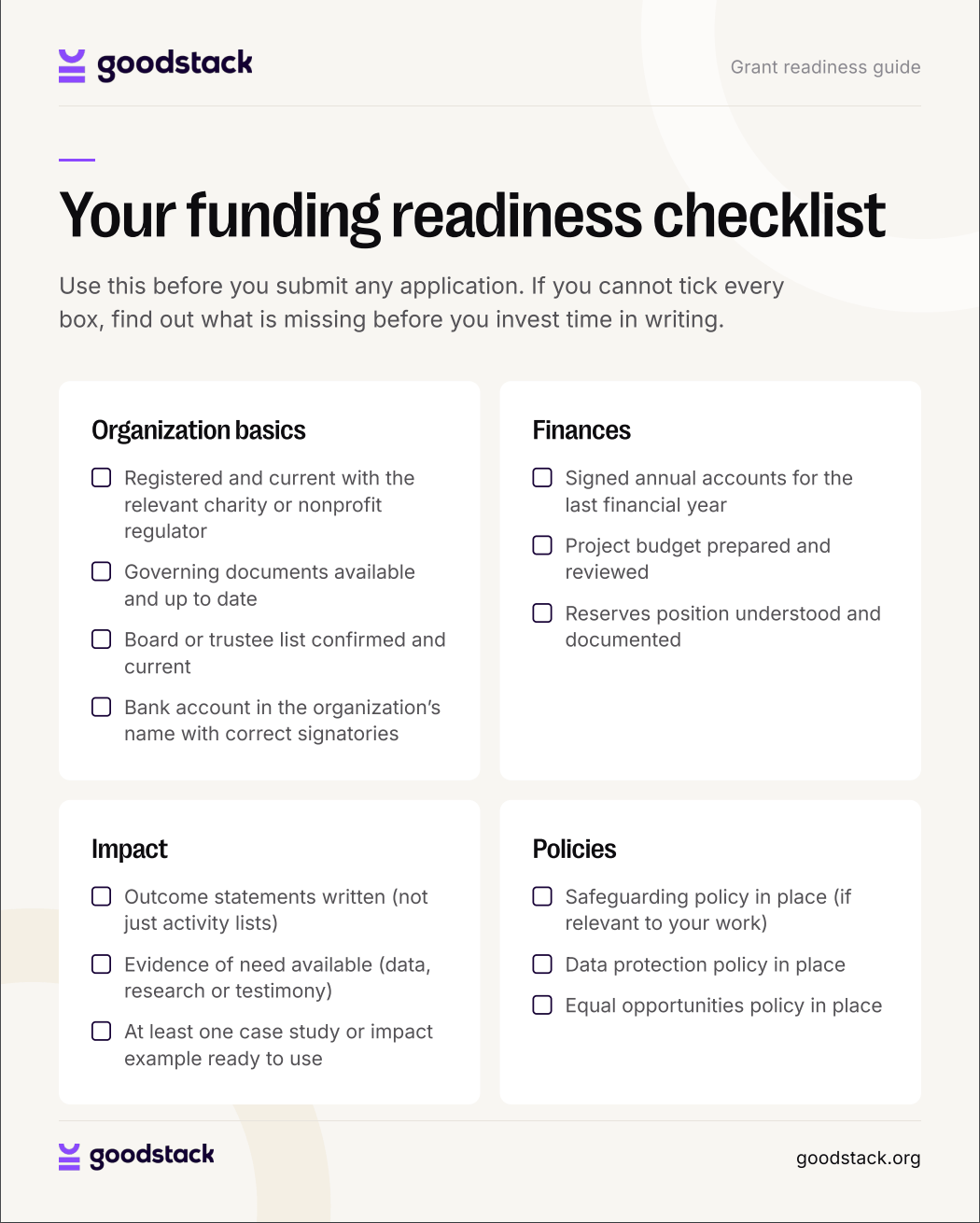
Use this before you submit any application. If you cannot tick every box, find out what is missing before you invest time in writing.
A note on doing this once and using it many times
The most time-consuming part of applying for funding is not the writing - it is finding the same information every time you apply. Build a simple folder with all of the documents above and keep it updated. When a new opportunity comes up, you will be ready in hours rather than days.
A library of approved paragraphs describing your organization, your impact and your approach means you are not starting from scratch every time. Funders see thousands of applications. organizations that apply consistently and clearly - with the same quality of evidence every time - win more funding over time.
Find grants matched to your organization on Goodstack
Your Goodstack account includes a grant finder that searches thousands of opportunities and matches them to your cause automatically. Log in at causes.goodstack.io or create a free account at goodstack.org.